Introduction
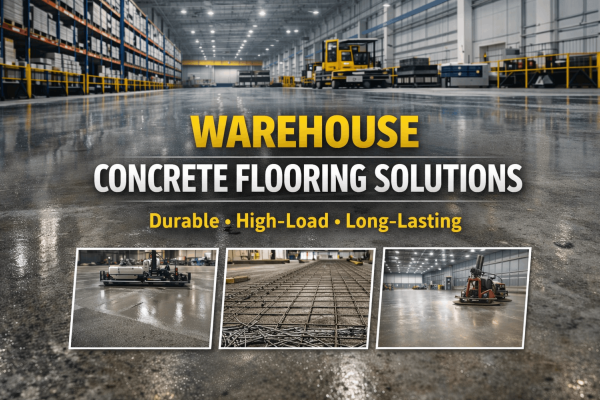
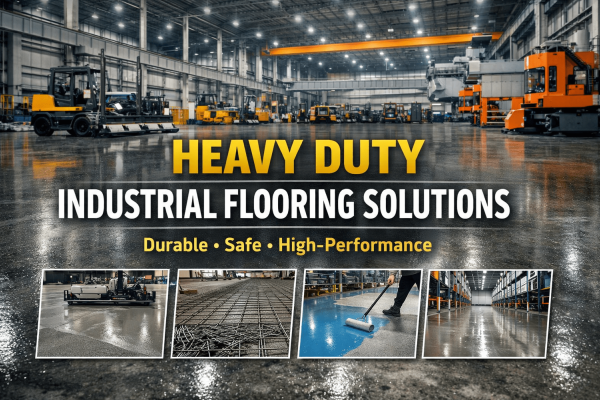
Warehouses operate under demanding conditions. From heavy pallet racks and forklifts to constant loading and unloading activities, the flooring must withstand extreme pressure and continuous movement. This is why warehouse concrete flooring solutions are engineered to deliver strength, durability, and long-term performance.
Choosing the right industrial concrete flooring system is essential for operational efficiency, safety, and cost control. A poorly constructed warehouse floor can lead to cracks, uneven surfaces, maintenance expenses, and safety hazards. In this blog, we explore the best concrete flooring solutions for warehouses, their benefits, and key factors to consider before installation.
Why Warehouse Flooring Requires Specialized Concrete Solutions
Warehouse floors are exposed to:
✔Heavy static loads from storage racks
✔Dynamic loads from forklifts and pallet trucks
✔Abrasion from tire movement
✔Impact from dropped materials
✔Temperature and moisture variations
Standard concrete is often insufficient for such high-performance environments. That is why specialized warehouse concrete flooring solutions are designed with enhanced strength, reinforcement, and surface finishing techniques.
Key Features of Warehouse Concrete Flooring Solutions
High Load-Bearing Capacity
Warehouse floors must support heavy machinery, storage systems, and continuous traffic without cracking. Reinforced concrete systems such as SFRC flooring solutions (Steel Fiber Reinforced Concrete) provide improved structural performance.
Superior Flatness & Levelness
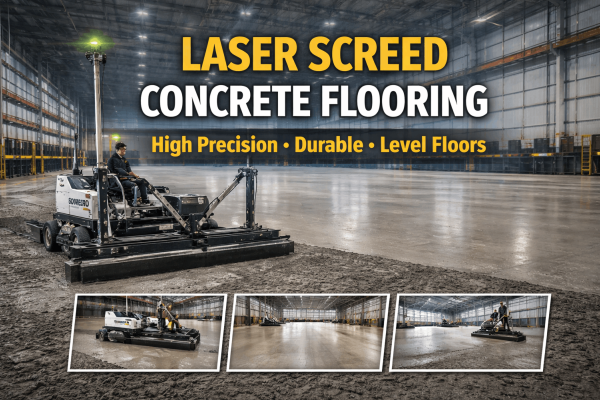
Automated storage systems and forklifts require high flatness values. Laser screed concrete flooring ensures precision leveling, reducing vibration and improving operational efficiency.
Durability & Abrasion Resistance
Warehouse concrete floors are designed to resist wear and tear caused by heavy vehicle movement and material handling.
Low Maintenance
Properly installed warehouse flooring reduces repair costs and minimizes downtime.
Dust-Free Surface
Surface treatments like floor hardeners and polishing reduce dust formation, improving air quality inside the warehouse.
Types of Warehouse Concrete Flooring Solutions
1. Laser Screed Concrete Flooring
Benefits:
✔High flatness (FF & FL standards)
✔Faster installation
✔Improved load distribution
✔Suitable for automated warehouses
2. Steel Fiber Reinforced Concrete (SFRC) Flooring
SFRC flooring incorporates steel fibers directly into the concrete mix to enhance crack resistance and strength.
Advantages:
✔Reduced need for traditional reinforcement
✔Improved impact resistance
✔Better load-bearing performance
✔Longer lifespan
This system is ideal for high-traffic warehouse environments.
3. TRIMIX Flooring
TRIMIX flooring uses vacuum dewatering technology to increase concrete density and strength.
Best for:
✔Industrial warehouses
✔Logistics hubs
✔Storage facilities
It provides a durable and abrasion-resistant surface.
4. Floor Hardener Concrete Systems
Dry shake floor hardeners improve surface strength and wear resistance.
Benefits include:
✔Increased durability
✔Dust-free finish
✔Improved surface life
This is commonly used in large warehouse flooring projects.
Benefits of Investing in Quality Warehouse Concrete Flooring
Improved Operational Efficiency
Smooth and level warehouse floors reduce forklift vibration, minimize equipment damage, and improve workflow.
Enhanced Safety
Crack-free and slip-resistant surfaces reduce workplace accidents.
Long-Term Cost Savings
Although high-quality warehouse concrete flooring solutions may involve higher initial costs, they significantly reduce maintenance and repair expenses over time.
Better Load Management
Properly designed concrete flooring distributes loads evenly, preventing structural damage.
Applications of Warehouse Concrete Flooring Solutions
Warehouse concrete flooring is widely used in:
✔Distribution centers
✔Cold storage warehouses
✔E-commerce fulfillment centers
✔Manufacturing warehouses
✔Industrial storage facilities
Each warehouse type may require customized flooring specifications depending on load intensity and operational needs.
Installation Process of Warehouse Concrete Flooring
Professional installation ensures durability and long-term performance. The typical process includes:
✔Sub-base preparation
✔Reinforcement placement (if required)
✔Concrete pouring using laser screed or TRIMIX technology
✔Surface finishing and leveling
✔Application of floor hardener or polishing
✔Curing and quality inspection
Proper curing is essential to achieve maximum strength and durability.
Common Problems with Poor Warehouse Flooring
Without proper design and execution, warehouse floors may face:
✔Cracks and joint failures
✔Surface dusting
✔Uneven settlement
✔Rapid wear and tear
✔Increased maintenance costs
Choosing professional warehouse concrete flooring solutions helps prevent these issues.
Key Factors to Consider Before Choosing Warehouse Flooring
Before selecting a warehouse flooring system, evaluate:
✔Load requirements
✔Traffic intensity
✔Rack layout
✔Surface flatness standards
✔Environmental exposure
✔Expansion joint design
Consulting flooring experts ensures optimal results.
Why Professional Warehouse Concrete Flooring Services Matter
Experienced flooring contractors ensure:
✔Accurate mix design
✔Correct thickness calculation
✔Proper joint planning
✔High-quality finishing
✔Long-term durability
Expert installation plays a crucial role in the performance of warehouse floors.
Conclusion
Warehouse operations depend heavily on strong and reliable flooring systems. Investing in high-quality warehouse concrete flooring solutions ensures durability, safety, and operational efficiency. From laser screed concrete flooring and SFRC systems to TRIMIX and floor hardener solutions, modern warehouse flooring technology offers advanced performance for demanding industrial environments.
A well-constructed warehouse floor not only supports heavy loads but also reduces maintenance costs and enhances productivity for years to come.